It seems like an eternity since ID Software shocked the world by making a good Doom reboot in 2016, proving that the tried-and-true genre of the FPS, a genre they helped to create in the first place, could be more than the stagnating trope it was slowly becoming. I didn’t get around to the game until mid-2018 – a mixture of lacking a platform to play it on and sheer ignorance on my part – but when I finally did it quickly became my favorite shooter of all time, and immediately I hungered for a sequel. That sequel is finally here, and I spent well over a week after launch playing it constantly, only stopping to write for this site. At some point while blasting through Doom Eternal’s later missions, I came to a realization.
This is the greatest first-person shooter I have ever played.
And honestly? The competition isn’t even that close. In my time playing games I have played tons of shooters, and enjoyed most of them, but ultimately nothing has captivated me so viscerally as this masterwork. Let’s dive in.

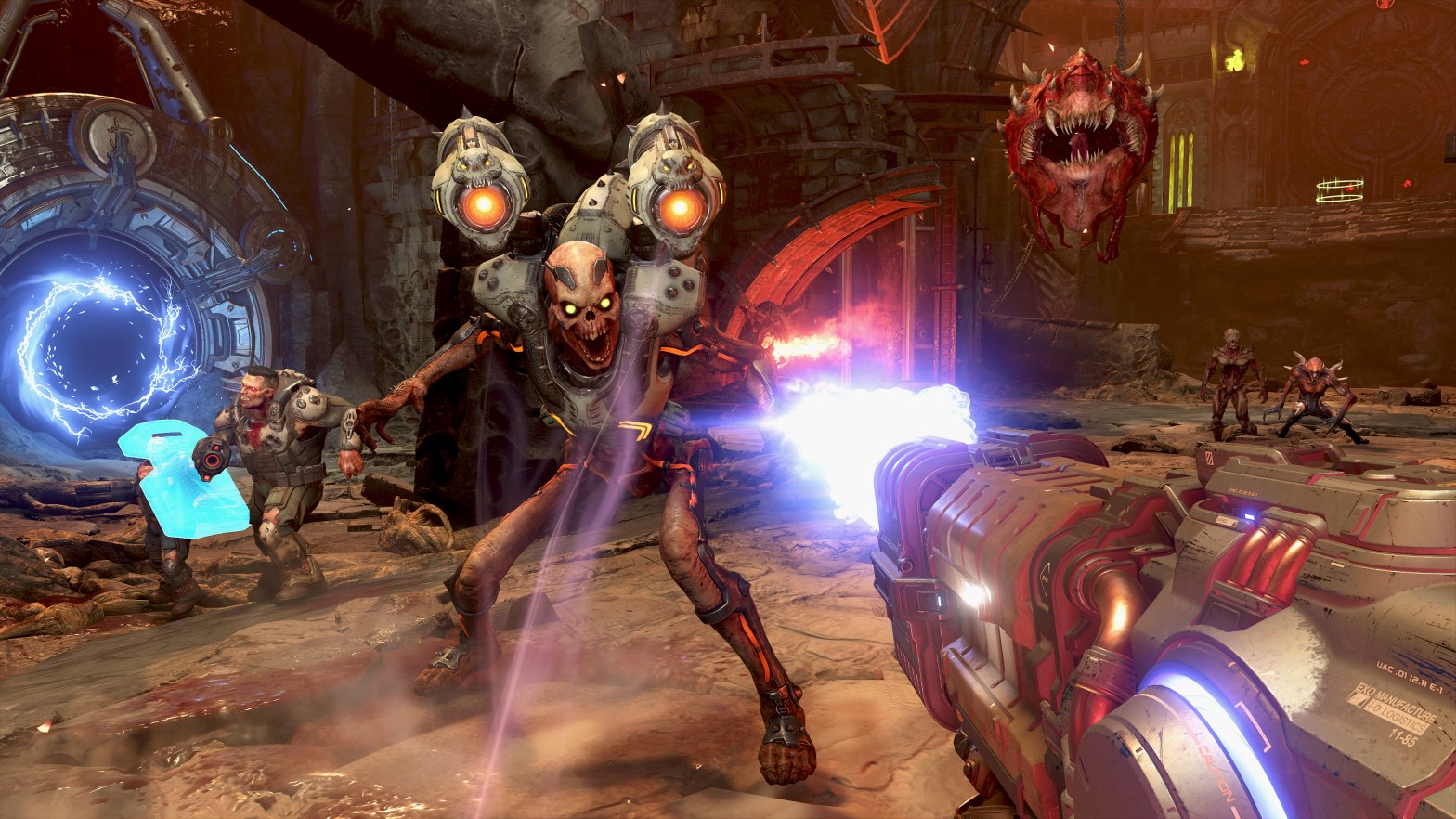
A main point of anticipation leading up to Doom Eternal’s release for me was absolutely the visuals. They were incredible from not only a tech perspective (though there is no lack of impressive tech involved) but in their massive variety and color palette. Nearly every environment is distinct, and nearly every level unique. Through the ~15 hour campaign you’ll blast demons through ravaged cityscapes, space stations, ancient ruins overrun by foliage and, of course, hell. Relative to the 2016 game this is a massive step up. While the graphical fidelity of 2016 was undeniable, there were few levels that stood out visually from one another — an issue that is indisputably rectified this time around.
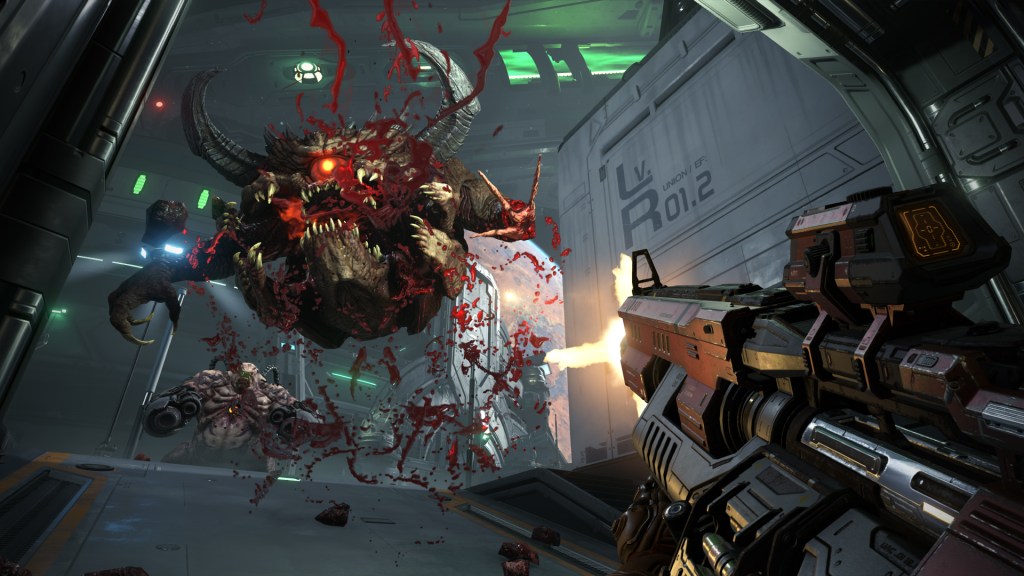
Elements of combat have been tweaked visually to give the gameplay a more visceral punch, with returning glory kills being tweaked to fit the Doom Slayer’s new toolkit and new ones remaining both creative and consistently entertaining. The enemy design and variety is also at an all-time peak, with veteran demons like the Revenant and Cacodemon being adjusted to better fit the newer, less grounded visual style (a controversial decision, but a fitting and welcome one in my book,) and new additions to the series, like the Whiplash and Mecha Zombie, fitting seamlessly into the massive cast of incredibly distinct enemies created solely for you to destroy. A new, incredible tech addition is the “Destructible Demons” system, by which enemies visually take various forms of physical damage with each hit. Shooting a Hell Knight in the arm with a shotgun will tear that arm right down to the bone, (a bone that can be broken and used to impale said hell knight’s skull, by the way) and Arachnotrons can be reduced to piles of blue mush by a single volley of rockets, leaving them significantly more vulnerable. It can be easy to miss with the intense speed of gameplay, but these details do wonders for the overall experience, and are hugely appreciated.
Along with some more cartoonish, “video game-y” enemy designs, Doom Eternal brings a flush of color to the HUD and gameplay elements, with ammo types being color-coded and really popping against the background, and the UI having a far more vibrant color palette, with contrasting greens, purples, and reds giving everything a more retro feel. It’s a welcome addition for me, but one that I absolutely understand not gelling with everyone, especially if you loved the more grounded style of 2016.
I hesitate to mention my only issue with the visual aspect of Doom Eternal because I’m fairly certain it is an issue with my system, and not the game, but I feel like I wouldn’t be doing my job here if I didn’t. I experienced many framerate dips throughout the game. It never went below 40fps, but it was noticeable, and fairly frequent. I do not have fantastic hardware, so I assumed it was on my end, and it still may be, but running a performance checker showed that I was running well below maximum in every field, and the issue was on every graphical setting. It was never enough to diminish my enjoyment while playing, but it is worth noting in case anyone is having a similar issue.
Overall the visuals of Doom Eternal are, to me, a massive improvement over the 2016 game in every way, and I was constantly taken aback by the spectacle I was engaging with. It truly is a visual powerhouse to behold.
The previous game definitely had a story, but it was seemingly secondary in every way, and could be easily pushed to the background for anyone who would have preferred a purely gameplay-focused experience. Under the facade of its “play comes first” intention, however, was an incredibly deep lore found in codex entries detailing every aspect of the Doom universe, all written with a deadpan seriousness that only works because it’s clear that both the writer and the reader know how ridiculous it all is. Both of these elements return in Doom Eternal, but under a far brighter spotlight.
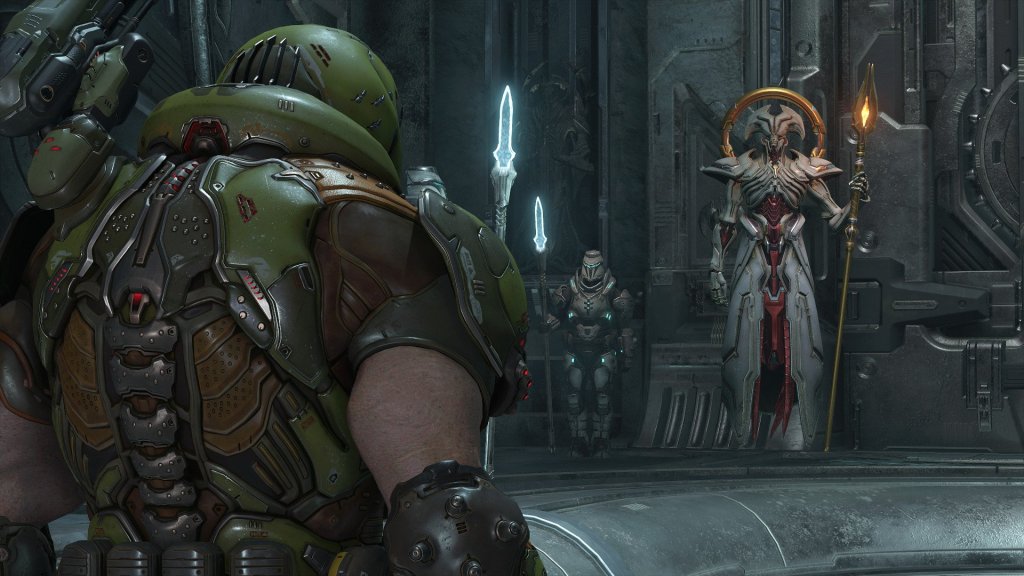
For better or worse, the story in Doom Eternal is front-and-center. The Doom Slayer’s objective is no longer just to kill every demon he gets his hands on, (though that’s certainly still a motive,) but there are motives far greater than him at play, with the fate of humanity in the hands of multiple factions with their own motivations. The plot is visually delivered in gameplay, but far more prominently it is delivered through frequent cutscenes, at least one per level. These cutscenes break the first-person perspective and show interactions between the Doom Slayer and representatives of the aforementioned factions, both peaceful and… not.
This decision will absolutely be a point of contention for players as they make their way through Doom Eternal. While I personally enjoyed the story and its many twists and turns, and was not distracted by the representation in cutscenes, there will absolutely be players who hate this decision and would have preferred it either remain in first-person, or not contain any cutscenes whatsoever. There is absolutely the option to skip these cutscenes, and if you don’t care about the story whatsoever that is a very viable option, but it is unfortunate that there is no option for people who would like to see the story but do not enjoy small movies in their games. It was not an issue for me, but there’s definitely a section of fans who this game may not serve.
The lore and codex entries make their return as well and are exactly as you remember them from the last game: incredibly intricate, detailed, and played completely straight-faced. They’re incredibly interesting if you want to take the time to read them, and one hundred percent optional which is, to me, a testament to how much passion the people at idsoft have for the series, to put in so much effort that the majority of people will not see.
But all of this story and visual spectacle is utterly pointless if the game to go alongside it isn’t good, right? It’s time to finally answer the question you probably wanted the answer to in the first place: how does the game play?
Doom Eternal plays better than any FPS on the market right now.
I am well aware of the gravity of that statement, but I have complete confidence when I say that there is no First-Person Shooter I would rather interact with than Doom Eternal.
Anyone who’s played Doom 2016 will tell you that the combat of that game centers around a core loop of resource management through aggression. It mandates aggressive play through the ‘Glory Kill’ system, through which you regenerate health by getting up close and personal, executing enemies with a visceral melee animation that spews health everywhere for you to pick up, allowing you to continue tearing through other enemies. An alternative to Glory Kills is the chainsaw, a tool you find limited fuel for throughout the level, and which replaces the health drops with ammunition of every type. The solution to every problem is to get more and more violent, blasting and tearing through everything in your path until you’re the last one standing.
Doom Eternal maintains this loop, and adds an extra few layers of depth on top of the already strategic gameplay of 2016. The most immediately noticeable change is the far more limited ammunition reserves, balanced by the regenerating chainsaw fuel. The chainsaw has three levels of fuel, the more fuel you have the larger the enemy you’re able to eliminate, same as the previous game. Here, however, the first level fills up over time, while the rest can be found in the levels, just like in the last game. The combination of these two mechanics facilitates an even more aggressive style of play, in which you rapidly seek out smaller “fodder” enemies to saw in half to keep your guns filled for the big ones, and leaves a layer of strategy in saving your fuel for the larger enemies, if you want to get rid of them in one hit.
Another resource that has been modified to encourage quick and aggressive play is that of armor. Previously, the only way to obtain armor was through pickups throughout the levels. That is still an option of course, but in Eternal a new weapon has been added to the arsenal: The Flame Belch. Essentially a shoulder-mounted flamethrower, the Flame Belch sets anything in front of you ablaze, allowing you to kill them faster and, when they die or take damage, causing them to drop armor everywhere. This applies any time an enemy is on fire, and once again continues the theme of “if you want something, you gotta kill something to get it.”
This brings us to the main tool of interaction with the game’s systems: the guns. Doom Eternal brings back a majority of the weapons from the previous games, with some notable changes and updates. The pistol has been completely removed from the game for the first time, seemingly a statement on the game’s message of pure aggression which the weakness of the pistol directly opposes, and in its place on the weapon wheel comes the BFG, which has been upgraded to weapon status rather than a hotkey “kill button.” Every other weapon returns, with the Gauss Cannon being renamed to the Ballista, and all of them are given a truckload of upgrades to work towards. Each weapon has two upgrade paths, each a different “mode” for the weapon, and each path can be upgraded to add more features, allowing you to truly customize your toolkit to fit your needs for creative killing. My personal favorite is the Meathook, an upgrade for the Super Shotgun that is literally a grappling hook, launching you towards the enemy to get close enough for a shotgun shell to the face (There’s even an upgrade that makes hooked enemies catch fire.)
The Meathook highlights another addition to Doom Eternal’s gameplay loop, the mobility. The double-jump returns and is immediately available, but more interestingly is the addition of the dash, a single button press that works like a dodge in many modern games. This is incredibly useful not only in combat, but in the new platforming sections. Platforming existed in Doom 2016 between combat sections, but it’s taken to a whole new level in Eternal, with climbable walls, air-dashes, and horizontal bars to swing off of like some kind of demon-slaying monkey. It’s this game’s way of offering space between combat encounters while never disengaging the player, and I found myself thoroughly enjoying it.
A couple more notable elements of combat before moving forward. Grenades are back, with a shoulder-mounted launcher similar to the Flame Belch that can also shoot ice bombs. I often found myself forgetting these existed, but when I remembered them it often made a huge difference in the outcome of the battle. A new mechanic called Blood Punch makes its debut, a limited-use melee move that instantly kills small demons and staggers large ones, and is also essential for knocking the armor off of some enemies.
It wouldn’t be a Doom game without memorable levels, and I must say that even after only my first playthrough it was incredibly easy for me to recognize every single level and its layout when I saw it played by someone else. This was obviously aided by the fantastic visual design, but the play spaces themselves felt more alive than ever in Doom Eternal. This is largely in part due to the increased mobility and faster pace, with every swinging bar and jump pad ingrained into my memory, but I also think that the enemy placement does a lot to push the player to make use of the terrain around them. No arena is ever too crowded to see every element, but they’re also packed with just enough enemies to force the player into a constant state of motion, evading fireballs and rockets at every turn.
Speaking of enemies, let’s talk about them. The majority of demons in Doom Eternal have weak points or weaknesses, which encourages a diverse playstyle and weapon selection throughout. Notable examples are the Arachnotron, a spider-like enemy with a turret on its back that you must destroy to stagger it and deal massive damage, and the Cacodemon, a flying beholder-like creature who opens its large mouth before every attack, making it incredibly easy to launch a grenade in there, blowing it up from the inside. Not every enemy is a hit, I groaned every time the snake-like Whiplash or the demon-summoning Archvile showed up, but they are simple enough to dispatch and never truly distract from the core gameplay loop. If you’ve played Doom Eternal, you probably know what I’m about to bring up. We need to talk about the Marauder.
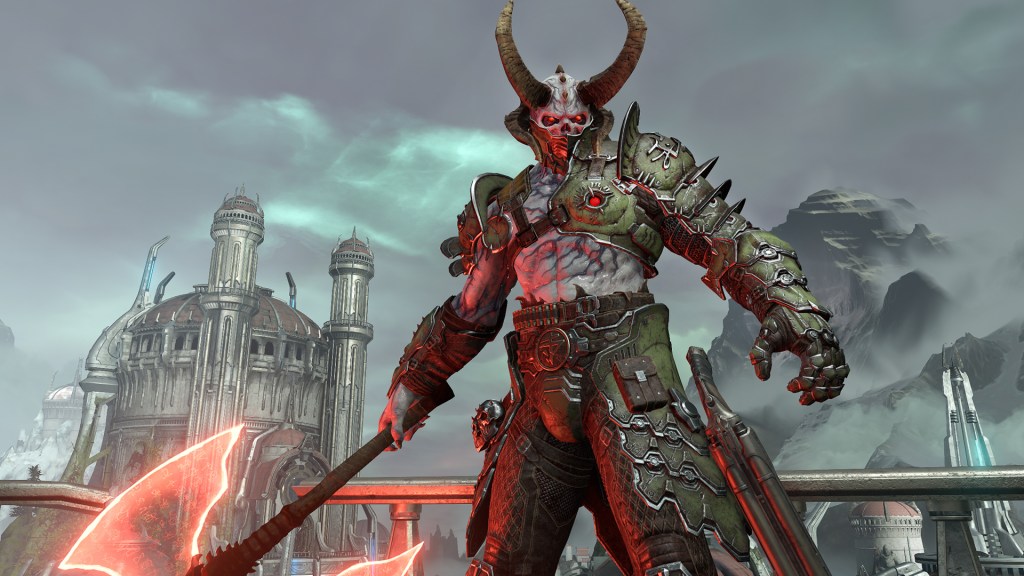
The Marauder is an enemy introduced a little under halfway through the game, and he is the single most talked about feature of the game, and the most widely hated. The Marauder is an enemy who is slated to be in a similar league to you in combat, and mechanically it shows. He has an axe, a shield, and a shotgun, all of which he uses in various situations. The tutorial popup you receive upon first confronting him says to keep at “medium range” to fight him, only attacking when his eyes flash green while he’s swinging his axe. Unlike other popups, though, this one is completely mandatory to follow, because if you don’t he will obliterate you. If you stay too close, he shoots you with his shotgun to knock you back, if you stay too far he launches an axe blade as a projectile, and if you attack him at any time when he’s not going for a melee hit, he brings up a shield that is completely invulnerable to any attack. He also summons a spectral dog to attack you as a distraction, though I never quite figured out what triggers it. It’s a waiting game where you stand at an unspecified range waiting for him to attack so you can hit him with a shotgun over and over again. In the context of being a boss, which is how he’s introduced, he’s a great breath of fresh air which forces you to switch up your strategy, the issue is that he doesn’t stay as a boss. In the latter half of the game he shows up during some normal combat encounters and completely destroys the flow of combat, forcing you to either ignore him in favor of the others enemies, just tanking his massive hits, or try and remain within his undefined “medium range” radius. It’s incredibly stressful and while it did not ruin the fun I was having, it was a distraction that I feel would have been aided if there was some way of circumventing him with either the BFG or another late-game weapon that I’ve not mentioned.
All of that being said, I don’t want this to paint a picture of the combat of Doom Eternal being flawed, that’s far from the case. Besides the Marauder there is not a single thing about the gameplay that I would change, and he is such an infrequent occurrence that it was never enough to bring me down from the euphoric high I was constantly riding from the sheer visceral enjoyment I got from playing the game. Doom Eternal plays smartly into the strengths of its predecessor and improves on them in nearly every single way.
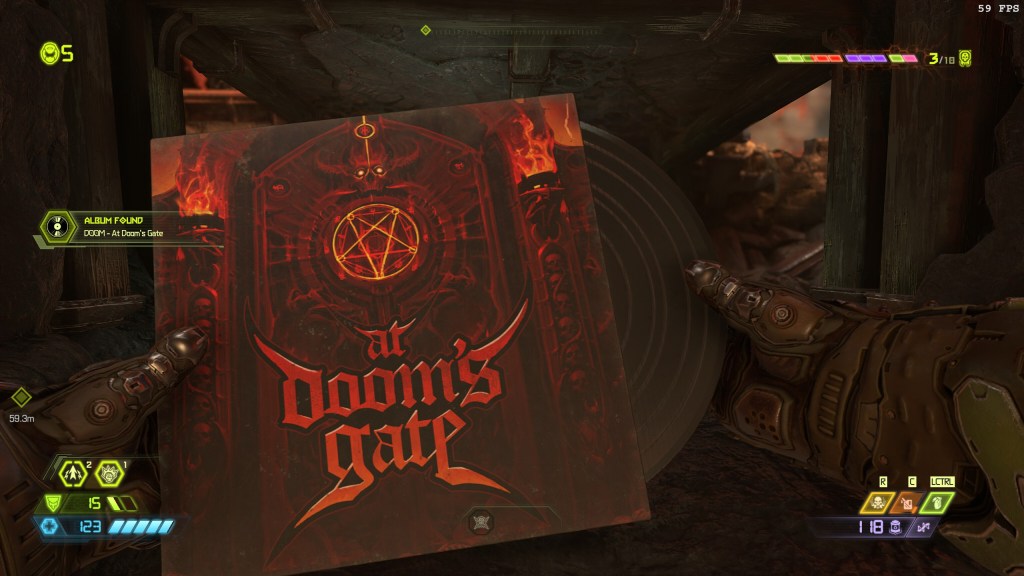
The part that excited me the most upon finishing the previous Doom installment was the incredible soundtrack by composer Mick Gordon. It made every instant of the game a brutally energetic rhythm of guitars, gore, and gunfire. Gordon pushed the envelope of video game music with his fantastic blend of downtuned extreme metal riffs (played on an absurd 9-string guitar,) crushing industrial riffs, and techno experimentation that brought forth what is possibly my favorite soundtrack ever composed – video game or otherwise. Doom Eternal does not change that and, while some may read that as an expression disappointment, I implore you not to.
It would be nearly impossible to overthrow the fantastically memorable and groundbreaking work on the original OST, but I think Gordon truly did come as close as anyone could expect with some key additions that still make the tracks stand out and remain consistently recognizable. The first of these elements to turn many heads, including my own, was the phrase “death metal choir” that got thrown around before launch. How such a wild concept could work and sound good is beyond me, but if anyone could do it it would be Mick Gordon, and wow did he ever succeed. The more human elements lend perfectly to the new setting and more human-centric story to give a tone entirely unique to this installment, without straying too far from the beauty of the original. The riffs on this OST are almost inarguably heavier, faster, and more intricate than in the previous installment, and while that occasionally leads to individual tracks being less memorable outside the game, it means that while the game is running there’s a palpable sense of speed and aggression even more notable than last time, seemingly reflecting the faster and more complicated gameplay.
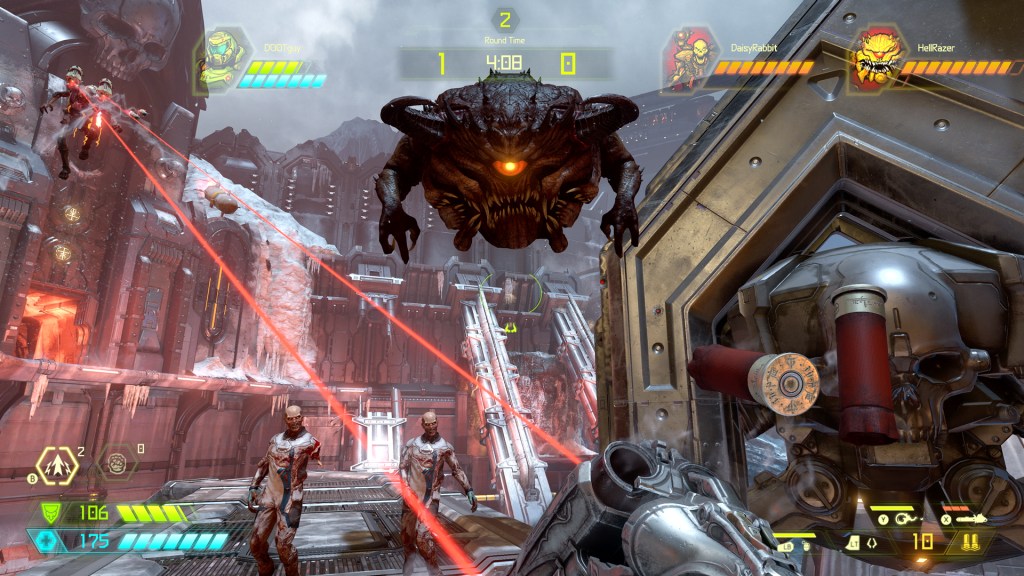
Outside obvious highlight of the main campaign, almost definitely the reason anyone will purchase this game, there is also an online multiplayer mode called Battle Mode, a 2v1 game mode in which one player controls the Doom Slayer, and the other two players team up as various demons from the game to take him down.
I will admit up front to not being much of an online gamer, most of the time once I finish a game’s main singleplayer offering I call it a day and move on, so I may not be the most qualified person to speak on things like weapon balance, refresh timers, and team strategy, but what I can speak to is fun, and I can confidently say that Doom Eternal’s Battle Mode with two friends is some of the most fun I’ve had in a multiplayer shooter in a while.
There’s something incredibly satisfying about teaming up as demons with another friend to take down the lone opponent with your variety of summon abilities, putting pressure on them until eventually they slip up and one of you manages to land that final blow. There’s definitely a learning curve, no denying that, but it didn’t take more than a couple matches until all my friends were on the same page and having a blast. The Doom Slayer plays exactly as he does in the campaign, which would leave one to assume that there would be an automatic experience imbalance, but having intelligent enemies plus the inability to slow down time while switching weapons leads to a constantly fun mode that, while I don’t have a large amount of experience with it, definitely kept me coming back longer than I thought after I finished the campaign.
Besides the Battle Mode, what can players expect from Doom Eternal after the credits roll? Well, alongside a slew of difficulty options to test your skills (including the return of the terrifying Ultra-Nightmare mode,) and a Lives mode that forces you to rely on 1-ups found around the level or risk losing all your progress, there’s also the return of the staple secrets, collectibles, and optional areas.
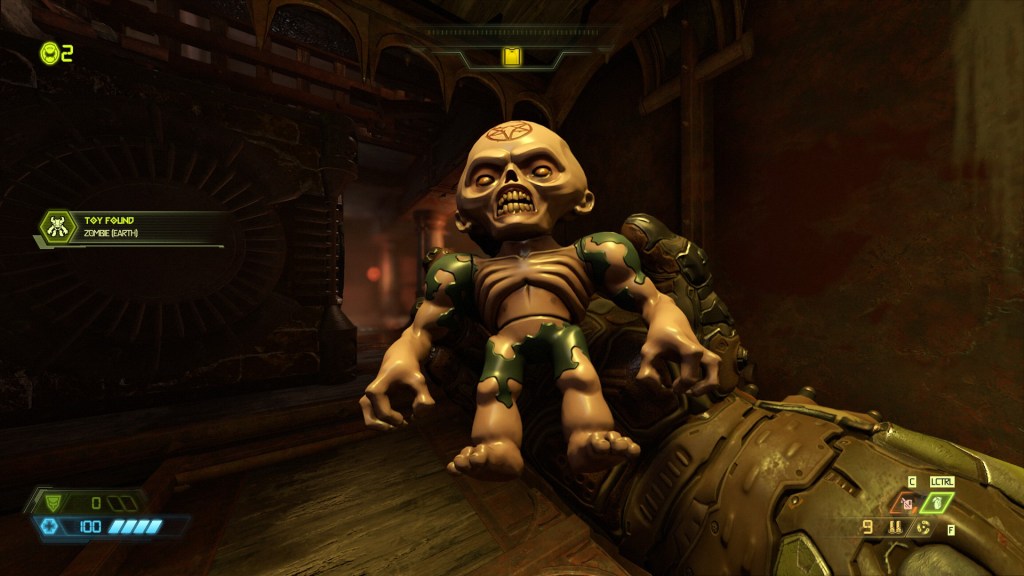
Unlike Doom 2016, where secrets were utterly hidden, secrets are marked on the minimap and even visible in-game with a “?” marker. The question is now simply how to get to the secrets, rather than where they are in the first place. This may be a disappointment for completionists who love a challenge, but for me it’s a welcome change, as in the previous game I ended up just using a collectibles guide after a certain point. The collectibles take the form of various objects for use in the hub area, with cute action figures to sit on the shelf (which I would absolutely buy in real life by the way,) vinyl records of previous idsoft soundtracks, from Quake to Wolfenstein, all playable both in the Hub and in levels upon replaying them. Most notable, however, are the cheat codes, which allow the player to tweak the game to their exact preferences with a variety of modifications, from traditional ones like infinite ammo and health, to more joke-y ones like the “QuakeCon” mode which adds a cheering sound effect after every glory kill. These are all usable upon returning to a level, and do not affect your collectible progress, making this one of the most forgiving Doom games to complete, if you want it to be.
There are also optional combat segments in Gore Nests and Slayer Gates, the former being a timed challenge in the pre-existing location, while the latter is an incredibly difficult arena fight that whisks you away to another location and pits you against a horde of enemies with the only goal being surviving longer than the demons around you. Both of these elements are extremely fun and, while I have yet to attempt many of them, they will prove to be a worthy challenge to anyone in the market for such a thing. I would also note that there are remixed “Master Levels” in the game, which shuffle elements of previous levels and add far harder enemies for an even more challenging experience. I have yet to attempt these, but from what I hear they are brutal but rewarding.
Doom Eternal has more than enough content post-completion to keep me coming back for a long time, and I anticipate returning not only for the current content, but for the upcoming story DLCs that have been confirmed by Bethesda to be releasing some time in the future.

And with that, I feel I’ve said everything I want to say about this fantastic game. I truly loved every moment I spent with Doom Eternal, and will continue to do so for the foreseeable future. It was in no way hyperbolic when I said that this is my favorite FPS that I have ever played, its peaks of mechanical refinement and sheer unapologetic aggression leave me in a state of bliss that I struggle to compare to anything except the feelings I got from its predecessor. It goes without saying that I strongly recommend Doom Eternal to any fan of Shooters, and I sincerely hope that it will be an inspiration for anyone looking to create FPS’ in the future.
 Writing About Music and Games Sometimes